

Shopify vs Big Cartel: Best for Dropshipping Operations?
This is one of those comparisons that sounds more even than it actually is. Big Cartel was built for independent artists and makers selling their own, usually handmade, work in small quantities, not for running a dropshipping operation with suppliers, automated order forwarding, and shipping integrations. It's worth saying plainly up front: for dropshipping specifically, these two aren't really in the same conversation.
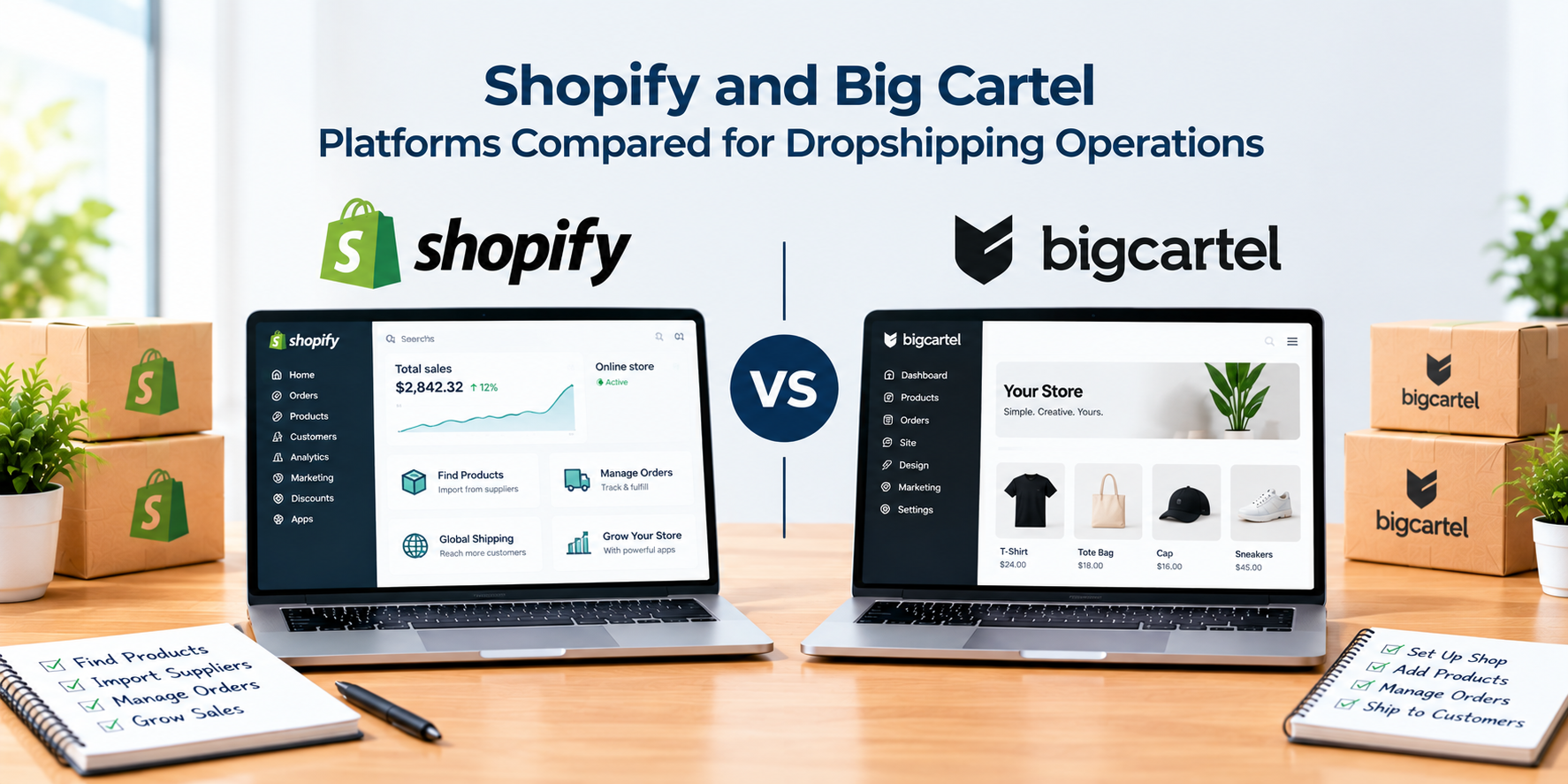
Big Cartel shows up in platform comparisons mostly because it's a recognizable name, not because it's actually built to compete with Shopify on dropshipping. It was designed for a very specific audience, independent artists, illustrators, and small-batch makers who want a simple, affordable way to sell their own original work online. Features like automated supplier order forwarding, deep shipping integrations, and scalable catalog management were never really the point.
That's not a knock on Big Cartel, it does its intended job well. But for anyone comparing it to Shopify specifically for dropshipping, the honest answer is worth spelling out clearly before building anything on it.
📋 Table of Contents
The Core Difference Between the Two
Shopify is built to scale, from a first-time dropshipping store to a large multi-channel operation, with an app ecosystem designed to support growth at every stage. Big Cartel is intentionally small-scale, with pricing tiers based on how many products you list, usually capping out well below what a catalog-driven dropshipping store would need. The two platforms were built to solve genuinely different problems, one for growth and automation, the other for simplicity and affordability on a small, personal catalog.
Why Big Cartel Isn't Built for Dropshipping
Dropshipping depends on automation, orders syncing to a supplier, inventory updating in real time, tracking numbers flowing back to the customer. Big Cartel's app marketplace is intentionally minimal, reflecting its focus on simple, self-made catalogs rather than supplier-driven ones. There are no major dedicated dropshipping integrations built for it, so running a dropshipping operation on Big Cartel would mean manually forwarding orders and tracking inventory yourself, exactly the kind of work a dropshipping app is supposed to eliminate.
Pros and Cons for Each Use Case
✓ Shopify Strengths
- Deep, automated dropshipping app ecosystem
- Built to scale from one product to thousands
- Strong fulfillment and shipping integrations
- Designed for supplier-driven business models
✗ Shopify Limitations
- More than most solo creators actually need
- Monthly fee plus app costs
- Overkill for a small, personal product line
✓ Big Cartel Strengths
- Simple, affordable for small catalogs
- Built specifically for independent artists and makers
- Clean, straightforward setup with no overwhelm
- Free tier available for a handful of products
✗ Big Cartel Limitations
- No meaningful dropshipping app support
- Product limits unsuited to a dropshipping catalog
- Minimal fulfillment automation
Who Big Cartel Actually Fits
Big Cartel makes genuine sense for an illustrator selling prints, a jewelry maker selling original pieces, or a small band selling merch, cases where the seller is the supplier, making or sourcing a small, personal catalog themselves rather than forwarding orders to a third party. For that kind of business, Big Cartel's low cost and simplicity are real advantages, not limitations.
Side by Side
| Factor | Shopify | Big Cartel |
|---|---|---|
| Dropshipping app support | Extensive | Minimal to none |
| Catalog scale | Built to scale | Intentionally limited |
| Target seller | Dropshippers, growing stores | Independent artists and makers |
| Cost for small catalogs | Moderate, scales up | Low, often free |
| Best for dropshipping | Yes | Not really |
Which One to Actually Pick
-
Confirm the Business Model First
If the plan is sourcing from suppliers and automating fulfillment, Shopify is the platform actually built for that. Big Cartel isn't designed around supplier relationships at all.
-
Consider Big Cartel Only for Original, Self-Made Work
If you're the one making or directly sourcing a small catalog of products yourself, Big Cartel's simplicity and low cost genuinely make sense.
-
Don't Force Dropshipping Onto the Wrong Platform
Trying to manually run a dropshipping operation on a platform without the integrations to support it usually costs more time than it saves in platform fees.
Ready to Set Up a Real Dropshipping Operation?
OneShipPros helps Shopify sellers connect reliable China sourcing and fulfillment to actually scale.
Get Started with OneShipPros →