
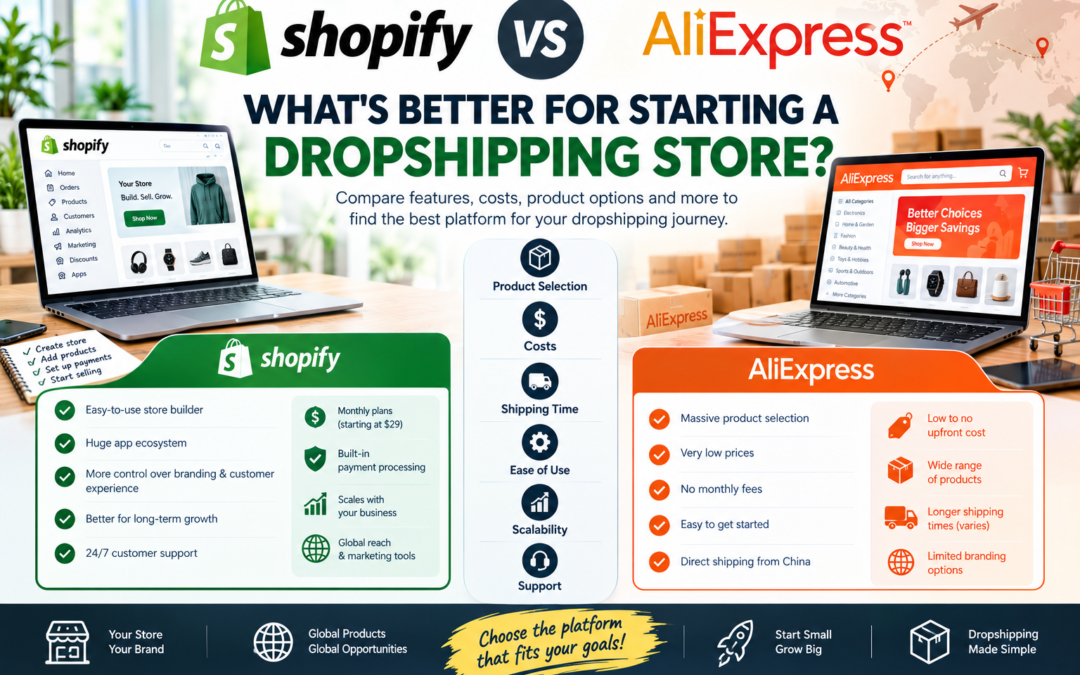
Shopify vs AliExpress: What's Better for Starting a Dropshipping Store?
Comparing Shopify and AliExpress head-to-head is a bit like comparing a storefront to a supplier, they aren't really competing for the same job. Shopify is where a customer buys, AliExpress is one place a product can come from. Understanding that distinction is the real starting point for anyone new to dropshipping.
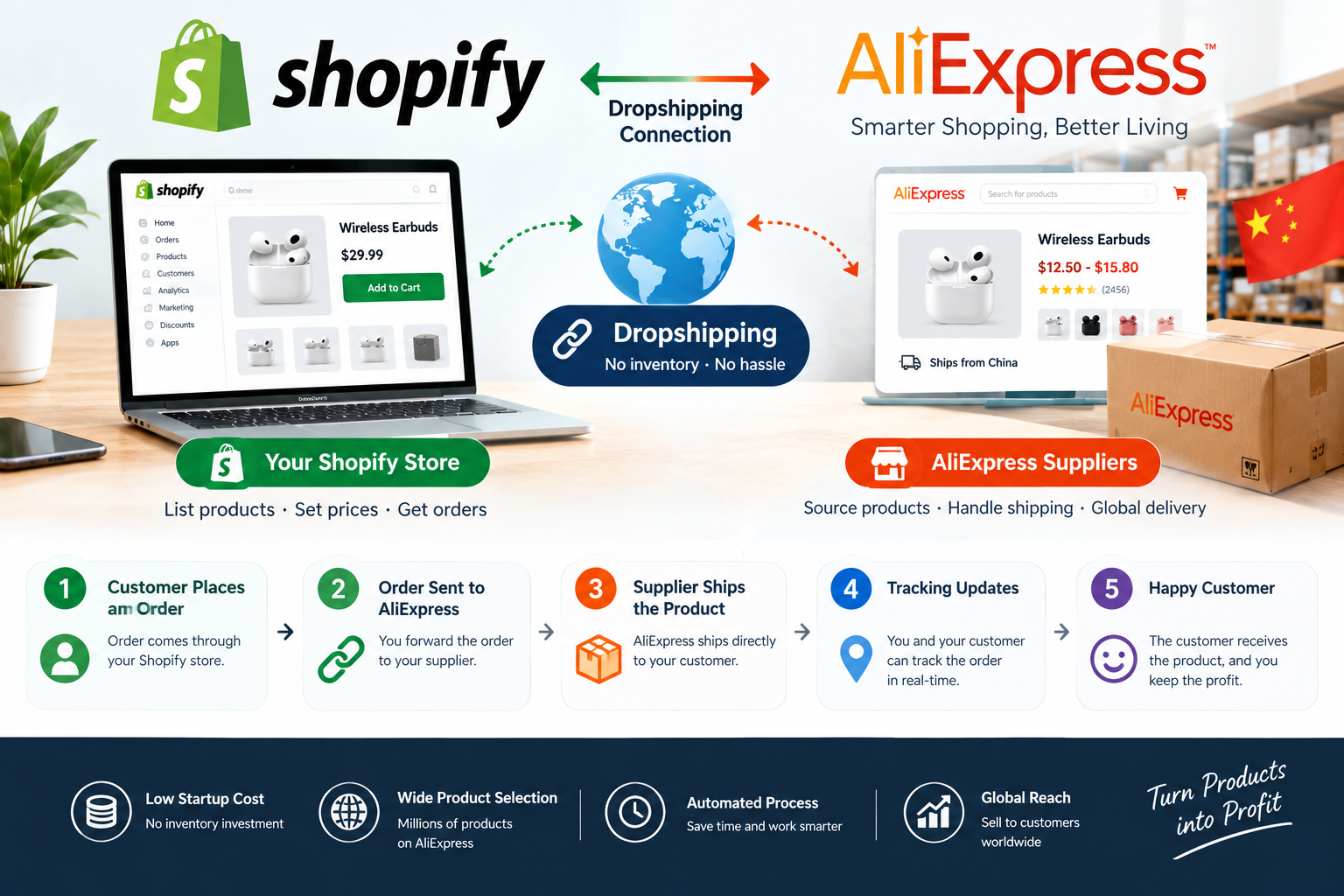
It's a common early question for someone new to dropshipping, and a fair one, but it starts from a slight misunderstanding. Shopify and AliExpress aren't really alternatives to each other; they solve different problems entirely. Shopify is the storefront platform where a customer actually browses and buys. AliExpress is a supplier marketplace, one option among several for sourcing the products being sold. In a typical setup, the two work together rather than in competition.
Here's what each one actually does, how they fit together in a real dropshipping business, and what to think about as that business grows.
📋 Table of Contents
What Shopify and AliExpress Actually Are
Shopify is an ecommerce platform, it hosts the store, handles checkout, processes payments, and gives a business its actual online storefront. AliExpress is a retail marketplace connecting buyers directly to sellers, mostly manufacturers and wholesalers in China, at consumer-accessible order quantities. Neither replaces the other, a dropshipping business generally needs a storefront to sell through and a product source to fulfill from, and Shopify and AliExpress fill those two different roles respectively.
How They Work Together in Practice
The common setup uses a dropshipping app, like DSers or similar tools, to connect a Shopify store to AliExpress listings. When a customer places an order on the Shopify store, the connected app can automatically place a matching order with the AliExpress supplier, which then ships directly to the end customer. This automation is what makes the AliExpress sourcing model practical at any real volume, manually placing each order individually wouldn't scale.
The Trade-Offs of AliExpress Sourcing
- Low barrier to entry — no upfront inventory investment makes AliExpress sourcing an accessible way to test product ideas with minimal risk
- Longer shipping times — orders typically ship individually from suppliers in China, often resulting in longer delivery times than a dedicated fulfillment warehouse offers
- Less quality control — without a direct relationship or quality check process, product consistency can vary more than with a vetted fulfillment partner
- Limited branding options — customizing packaging or including branded inserts is generally not possible with standard AliExpress dropshipping orders
When to Move Beyond AliExpress Sourcing
AliExpress dropshipping works well for testing whether a product idea has real demand, low commitment, fast to set up, easy to pivot. Once a product proves itself with consistent sales, many sellers transition to a dedicated China fulfillment warehouse, ordering inventory in bulk, storing it, and shipping faster and more consistently from there. This shift usually improves shipping speed, quality consistency, and opens up custom branding options AliExpress dropshipping doesn't support.
Shopify's Role vs AliExpress's Role
| Factor | Shopify (Storefront) | AliExpress (Supplier Source) |
|---|---|---|
| What It Provides | Customer-facing store and checkout | Product sourcing option |
| Role in the Business | Where customers buy | Where products come from |
| Necessary for Dropshipping | Yes, or an equivalent storefront | One option among several suppliers |
| Cost Structure | Monthly subscription | Per-order product cost |
Getting Started the Right Way
-
Set Up Your Storefront on Shopify
Build the actual customer-facing store, product listings, checkout, and branding, on a platform like Shopify designed for this purpose.
-
Use AliExpress to Test Product Ideas
Source initial products through AliExpress to test demand with minimal upfront commitment before deciding what's worth scaling.
-
Transition Proven Products to Dedicated Fulfillment
Once a product shows consistent sales, consider moving it to a dedicated China fulfillment warehouse for faster shipping and better quality control.
Ready to Move Beyond AliExpress Sourcing?
OneShipPros helps Shopify sellers transition to faster, more consistent China fulfillment.
Get Started with OneShipPros →