
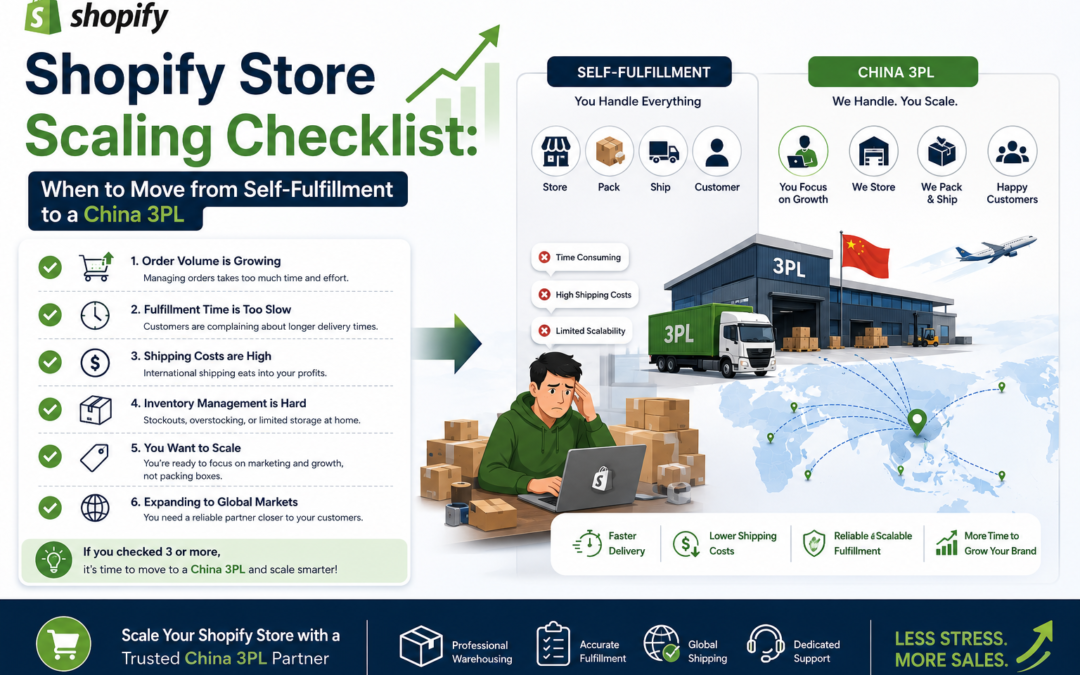
Shopify Store Scaling Checklist: When to Move from Self-Fulfillment to a China 3PL
Packing orders at the kitchen table works great until it doesn't. Here's a practical checklist to know whether your Shopify store has actually outgrown self-fulfillment, or whether it's too early to make the switch.
Self-fulfillment is how most Shopify stores start, and for good reason it's cheap, gives full control, and doesn't require trusting a stranger with your inventory before you've even proven the business works. But there's a point where packing boxes yourself stops being a scrappy advantage and starts being the thing holding growth back. The tricky part is knowing exactly when that point has arrived.
Rather than a vague "when you feel ready," here's a concrete checklist to run your store against.
📋 Table of Contents
Why Self-Fulfillment Works Well Early On
At low order volume, self-fulfillment genuinely makes sense. There's no monthly minimum, no need to trust a third party with unproven inventory, and full control over packaging and shipping timing. Every dollar saved on fulfillment fees goes straight to margin, which matters a lot when a store is still figuring out if a product will sell at all.
The math changes as volume grows, though, and it changes faster than most sellers expect.
Where Self-Fulfillment Starts to Break Down
Signs Self-Fulfillment Is Becoming a Bottleneck
- Packing orders eats into time needed for marketing or product development
- Shipping deadlines get missed during busier weeks
- Storage space at home or a small office is running out
- Per-unit shipping cost isn't improving despite higher order volume
Signs You're Still Fine Self-Fulfilling
- Order volume is still low and manageable within a normal workday
- Product line is still being validated, not yet a proven bestseller
- Current storage space comfortably fits inventory levels
- Shipping costs remain reasonable relative to order value
The Scaling Checklist: Signs You're Ready
Beyond the general signs above, a few more specific markers tend to show up right around the point where a China 3PL starts making financial sense: consistent, repeatable order volume on a handful of core SKUs, product margins healthy enough to absorb fulfillment fees without disappearing, and enough forecasting confidence to commit to a purchase order months ahead of when stock is needed.
It's also worth confirming your Shopify inventory and order management setup can actually support an external fulfillment integration before committing, since a 3PL relationship depends on clean data flowing both directions.
What to Prepare Before Making the Switch
- At least 3-6 months of sales history — this gives a fulfillment partner and yourself enough data to forecast reorders accurately
- A clear list of top-performing SKUs — identify which products actually justify the move first, rather than migrating the entire catalog at once
- A realistic fulfillment budget — calculate what storage, pick-and-pack, and shipping will actually cost at your volume before comparing quotes
- Packaging and branding requirements defined — know what level of custom packaging you want before requesting quotes
- A plan for the transition period — decide whether to migrate all at once or test with a subset of orders first
Self-Fulfillment vs China 3PL: Side by Side
| Factor | Self-Fulfillment | China 3PL |
|---|---|---|
| Time Commitment | High, scales with order volume | Low, warehouse handles fulfillment |
| Per-Unit Cost at Scale | Doesn't improve with volume | Improves with volume |
| Storage Space Needed | Your own space, limited | Warehouse-provided, scalable |
| Control Over Process | Full control | Shared, agent-dependent |
| Best For | Low volume, early validation | Consistent, scaling volume |
How to Test the Waters Before Fully Committing
-
Start With a Small Batch
Move your highest-volume SKUs first, keeping the rest self-fulfilled until the 3PL relationship has proven itself on real orders.
-
Monitor Closely for the First Few Cycles
Track order accuracy, shipping times, and customer feedback closely during the first month or two, since early issues are easier to catch and fix than later ones.
-
Expand Gradually Once Confident
Once the initial batch is running smoothly, migrate additional SKUs in stages rather than shifting the entire remaining catalog all at once.
Think You're Ready to Make the Switch?
OneShipPros helps Shopify sellers transition from self-fulfillment with a low-risk test batch, so you can validate the move before committing your whole catalog.
Get Started with OneShipPros →