
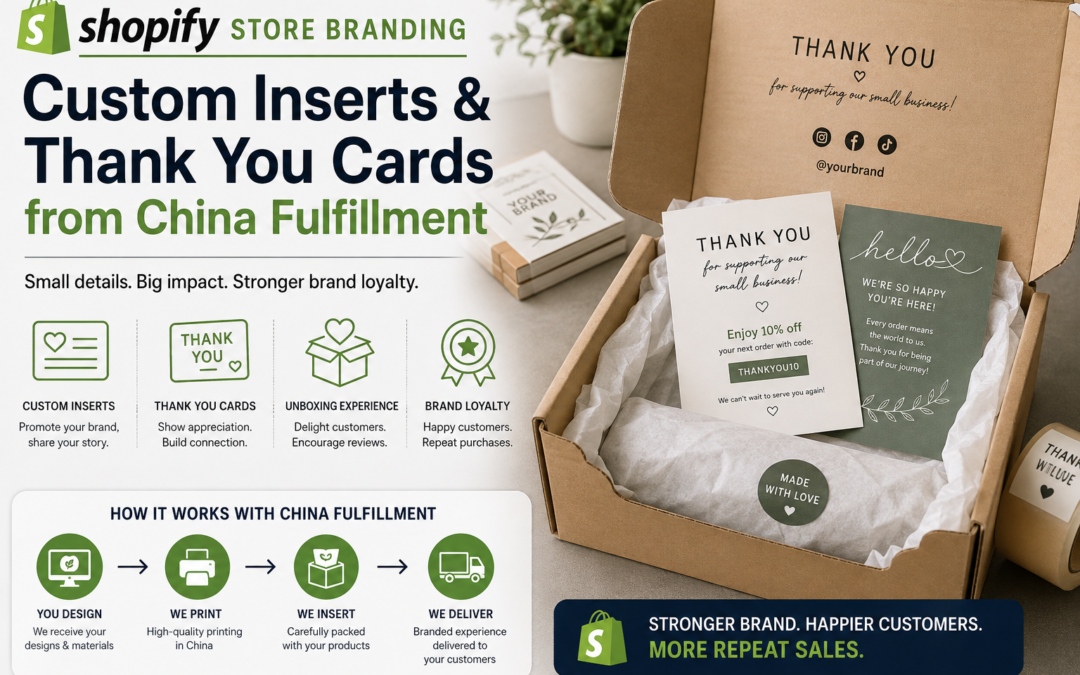
Shopify Store Branding: Custom Inserts & Thank You Cards from China Fulfillment
The moment a customer opens a Shopify order is one of the few times a brand gets their undivided attention, no scrolling, no distractions. A well-designed insert or thank you card is a simple way to make that moment count. Here's how to set it up through a China fulfillment warehouse.

Most of a Shopify store's branding lives online, the storefront design, the emails, the social presence. The physical package a customer receives is one of the only branded touchpoints that exists entirely offline, and it's often underused. A custom insert or thank you card is a low-cost way to extend brand identity into that moment, and it's something most China fulfillment warehouses can accommodate with the right setup.
Here's what to know about adding custom inserts and thank you cards through your fulfillment partner.
📋 Table of Contents
Why the Unboxing Moment Matters
Once a customer has the package in hand, the brand has their full attention for at least a few seconds, something that's genuinely hard to earn in a crowded digital feed. A generic shipping box with nothing inside but the product misses that opportunity entirely. A thoughtful insert, even something simple, can reinforce the brand, invite a review, or nudge toward a repeat purchase, all in a moment competitors on Shopify aren't necessarily using well.
What Happens Without a Deliberate Approach
Missed Opportunity Without Inserts
- A generic, forgettable unboxing experience
- No prompt for reviews or repeat purchases at a high-attention moment
- Brand identity that stops at the storefront, never reaching the physical package
- A missed chance to build customer loyalty cheaply
What Custom Inserts Provide
- A branded, memorable unboxing experience
- A natural prompt for reviews, referrals, or repeat orders
- Brand identity carried through to the physical product
- A low-cost way to build customer connection
Common Types of Inserts
Thank you cards are the simplest starting point, a short, personal-feeling note that acknowledges the purchase. Beyond that, sellers commonly use discount codes for a future order, QR codes linking to a review page or loyalty program, care instructions for the product, or small branded stickers. The right mix depends on the goal, whether it's driving repeat purchases, encouraging reviews, or simply reinforcing brand feel.

Setting Up Inserts with Your Fulfillment Partner
- Confirm insertion is offered — not every warehouse includes custom insert placement by default, and it may involve a small per-order fee
- Provide print-ready files in advance — supplying finished, print-ready designs avoids delays or quality issues on the warehouse's end
- Decide on insertion rules — specify whether the insert goes in every order or only specific ones, so it's applied consistently
- Order a test run first — placing a real test order helps confirm the insert looks and feels right before it goes out to real customers at volume
Printed Cards vs Digital Follow-Up
| Factor | Printed Insert/Card | Digital Follow-Up Email |
|---|---|---|
| Attention at Delivery | High, physical moment | Lower, competes with inbox |
| Cost per Order | Small added cost | Effectively free |
| Brand Memorability | Stronger, tangible | Depends on email design |
| Best Used For | First impression, unboxing | Ongoing engagement, reminders |
Getting Started with Custom Inserts
-
Design a Simple, On-Brand Insert First
Start with something straightforward, a thank you note or a discount code, rather than a complex multi-piece insert, and refine from there based on customer response.
-
Confirm Fulfillment Setup and Cost
Talk to your China fulfillment partner about their process for inserting custom materials, including any per-order fee, before finalizing the design.
-
Order a Test Shipment
Place a test order to see the insert in the actual package as a customer would, catching any placement or print quality issues before scaling up.
Want to Add Custom Branding to Your Orders?
OneShipPros helps Shopify sellers add custom inserts and thank you cards to strengthen their unboxing experience.
Get Started with OneShipPros →