
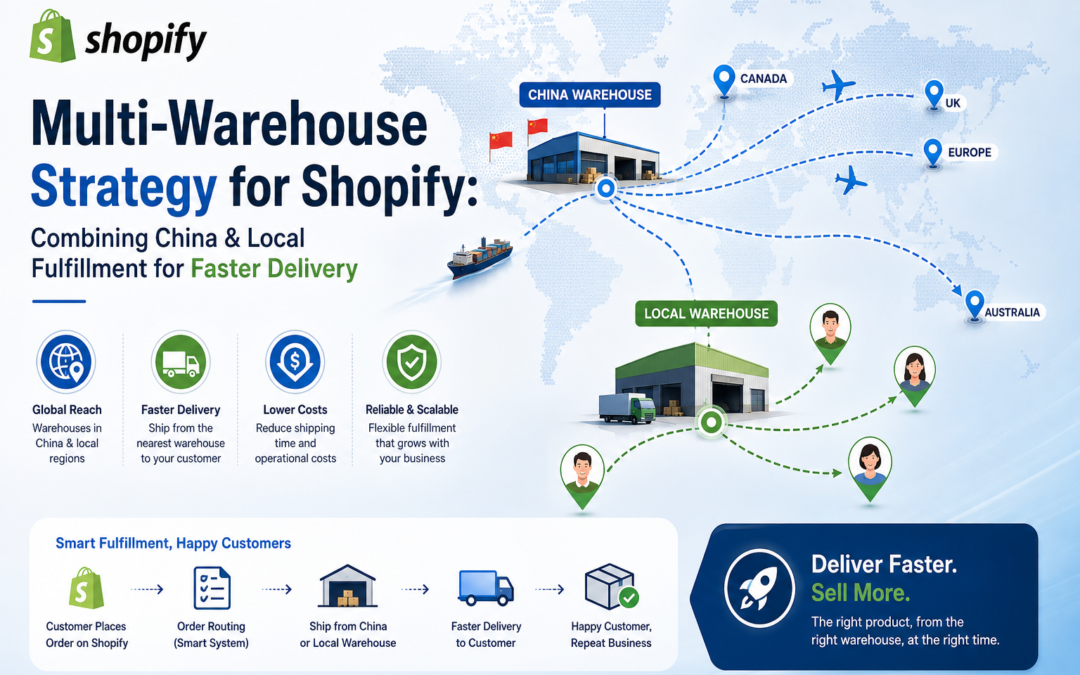
Multi-Warehouse Strategy for Shopify: Combining China & Local Fulfillment for Faster Delivery
It doesn't have to be China or local it can be both. Here's how Shopify sellers split inventory across a China warehouse and a local fulfillment center to get fast delivery on bestsellers without losing the cost savings that make sourcing from China worthwhile.
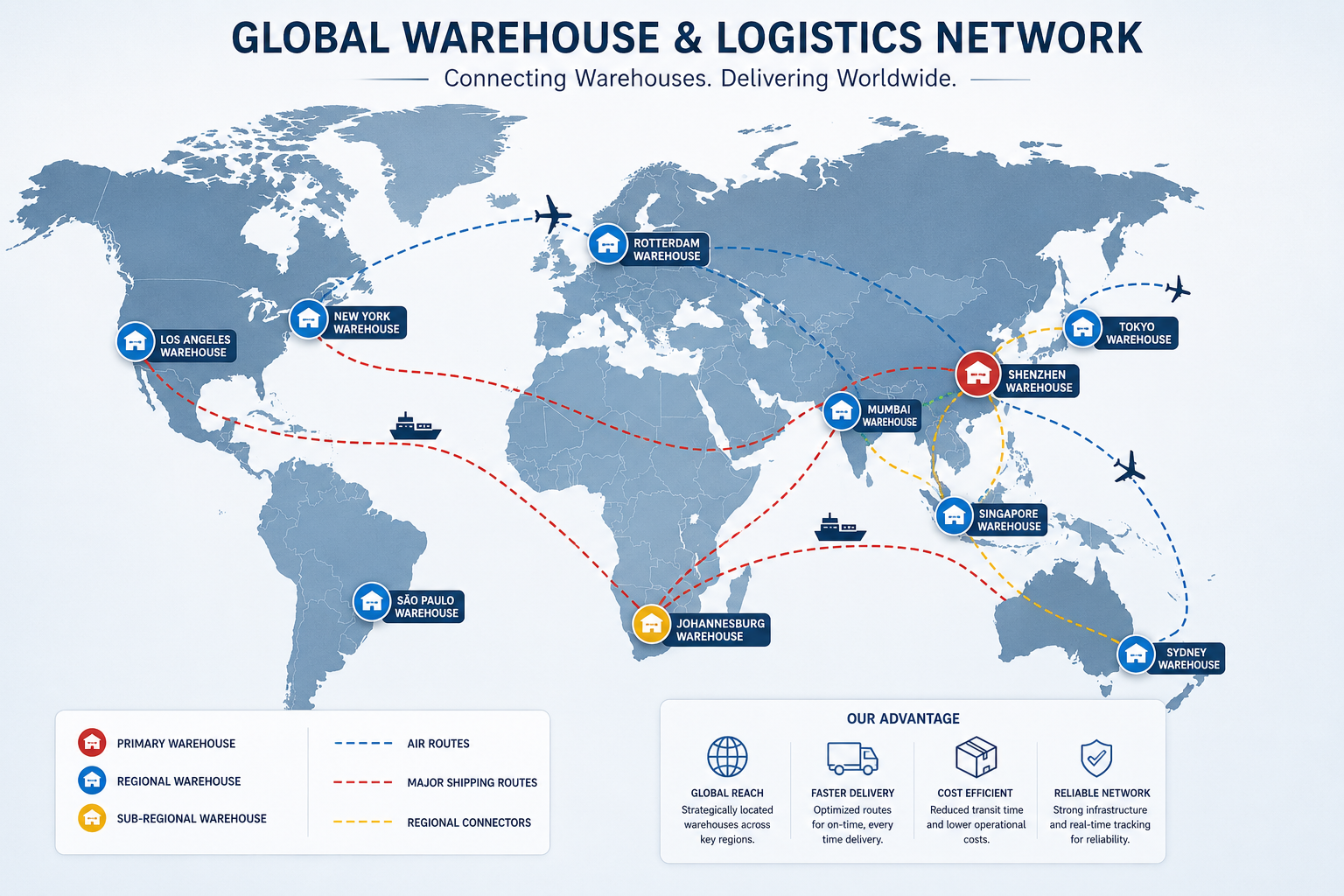
The China-vs-local fulfillment debate usually gets framed as a choice one or the other. In practice, a lot of established Shopify stores don't pick a side at all. They run both, splitting inventory so fast-moving bestsellers ship from a local warehouse while slower-moving or newly launched products stay in China at a lower storage cost. Done right, this gets the best of both without fully committing to either one's trade-offs.
Here's how a multi-warehouse setup actually works, and what it takes to run one without creating more problems than it solves.
📋 Table of Contents
Why Sellers Move Beyond a Single Warehouse
A single-warehouse setup is simpler to manage, and it's the right starting point for most stores. But as a catalog grows and certain SKUs prove themselves as consistent bestsellers, the trade-offs of a single location start to show either delivery is fast but expensive at scale, or cost-efficient but too slow for customers who expect quick shipping on popular items. A multi-warehouse setup exists specifically to resolve that tension rather than force a single compromise across the whole catalog.
Where Single-Warehouse Setups Hit Limits
Single-Warehouse Trade-offs
- All-local storage costs climb as SKU count and volume grow
- All-China storage means every order faces a long delivery window
- No flexibility to prioritize speed on bestsellers specifically
- New product launches compete with proven SKUs for the same storage cost structure
What a Split Setup Solves
- Bestsellers get fast, local delivery where it matters most
- Slower-moving stock stays at low-cost China storage
- New launches can start in China until demand is proven
- Overall fulfillment cost stays lower than an all-local approach
How a China + Local Split Actually Works
In practice, sellers typically identify their top-selling, most consistent SKUs and keep a working supply of those at a local fulfillment center for fast, per-order shipping. Everything else product lines still being tested, seasonal items, or slower sellers stays in China, either shipping direct to customers on longer timelines or getting bulk-freighted to the local warehouse on a periodic replenishment schedule. Shopify's order routing then needs to know which warehouse to pull from for each SKU, which is where the setup gets technical.
This depends heavily on Shopify's multi-location inventory features or a fulfillment app that can route orders correctly, since getting this wrong risks an order being fulfilled from the slower location by mistake.

What to Set Up Before Splitting Inventory
- Shopify multi-location inventory enabled — confirm your store is set up to track and allocate stock across more than one warehouse location
- Clear routing rules — decide how orders get assigned to a warehouse, whether by SKU, customer location, or stock availability
- Replenishment schedule between locations — plan how and when stock moves from China to the local warehouse to keep bestsellers stocked
- Unified inventory visibility — make sure you can see combined stock levels across both locations, not just each one separately
- Consistent packaging across both warehouses — confirm branded packaging is available and consistent whichever warehouse fulfills the order
Single Warehouse vs Multi-Warehouse: The Trade-offs
| Factor | All-China | All-Local | China + Local Split |
|---|---|---|---|
| Delivery Speed | Slower on every order | Fast on every order | Fast on bestsellers |
| Overall Cost | Lowest | Highest | Balanced |
| Complexity to Manage | Simplest | Simplest | More coordination needed |
| Best For | Low-volume, cost-focused stores | Stores needing fast delivery on everything | Stores balancing speed and cost by SKU |
How to Decide Which SKUs Go Where
-
Prioritize Bestsellers for Local Stock
Products with steady, high sales velocity benefit most from local storage, since the delivery speed improvement reaches the largest number of customers.
-
Keep Unproven or Seasonal SKUs in China
New product launches and seasonal items often don't yet justify the cost of local storage until their demand pattern is established over a few sales cycles.
-
Revisit the Split Regularly
Sales patterns shift review which SKUs qualify for local storage every quarter or so, moving products between locations as their performance changes.
Ready to Set Up a Multi-Warehouse Strategy?
OneShipPros helps Shopify sellers coordinate China storage with local fulfillment, keeping bestsellers fast without losing cost efficiency elsewhere.
Get Started with OneShipPros →