
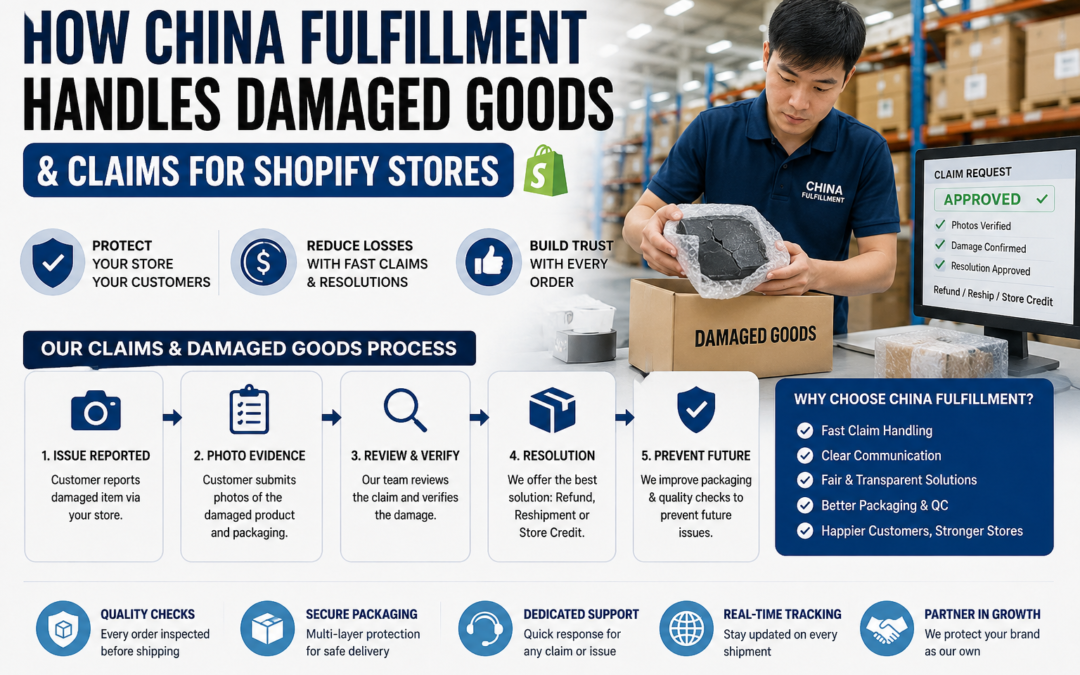
How China Fulfillment Handles Damaged Goods & Claims for Shopify Stores
Every fulfillment setup eventually deals with a damaged package it's not a question of if, but how well the process handles it when it happens. Here's how damage and shipping claims actually work with China fulfillment, and what to confirm before you need it.

Damaged goods happen in every fulfillment relationship, regardless of location a box gets crushed in transit, a fragile item breaks during handling, a shipment arrives with visible dents. What separates a manageable hiccup from a real problem isn't whether damage ever occurs, it's whether there's a clear, working process for what happens next.
Here's how damage and claims are typically handled when fulfilling Shopify orders from China, and what to have confirmed in advance so it doesn't become a scramble when it actually happens.
📋 Table of Contents
Where Damage Typically Occurs
Damage can happen at a few distinct points: during storage or handling at the warehouse before shipment, during the actual transit journey via the shipping carrier, or occasionally due to inadequate original packaging that wasn't sufficient to protect the product regardless of careful handling. Identifying which of these applies to a specific case matters, since it usually determines who's responsible for resolving it.
Where the Process Breaks Down Without a Plan
What Happens Without a Clear Process
- Confusion over whether the warehouse or carrier is responsible
- Slow replacement shipping while responsibility gets sorted out
- Customers left waiting without clear communication
- Disputes over documentation requirements after the fact
What a Clear Process Provides
- Pre-agreed documentation requirements, known in advance
- Fast replacement shipping while a claim is separately resolved
- Consistent customer communication templates ready to use
- Clear responsibility split between warehouse and carrier
How Responsibility Is Typically Determined
Generally, if damage is discovered before the package leaves the warehouse for example, caught during quality control the fulfillment agent is responsible for resolving it before it ever reaches the customer. If damage occurs during transit, the shipping carrier's claims process typically applies, since the package was in their custody at the time. Photographic evidence and documentation of the item's condition at key points (pre-shipment, upon delivery) become important in determining where responsibility falls.
Regardless of where responsibility lands, keeping the customer-facing experience smooth often means issuing a replacement quickly through Shopify's order and returns management tools while the underlying claim is resolved separately in the background.

What to Confirm With Your Fulfillment Agent
- Their damage documentation process — ask what evidence they capture before shipment (photos, condition notes) that could support a future claim
- Replacement policy for warehouse-caused damage — confirm how quickly a replacement ships if damage is caught before dispatch
- Support for carrier claims — clarify whether they assist with filing shipping carrier claims or if that responsibility falls entirely on you
- Typical claim resolution timelines — ask what's realistic to expect, so customer communication can be set accurately
- Packaging adequacy for your specific products — confirm they're using packaging appropriate for your product's fragility, not a generic default
Warehouse Damage vs Transit Damage: Who Handles What
| Damage Occurs | Typically Responsible | Resolution Path |
|---|---|---|
| During Warehouse Handling | Fulfillment agent | Direct replacement before shipment |
| During Carrier Transit | Shipping carrier | Formal carrier claims process |
| Due to Inadequate Packaging | Fulfillment agent (packaging choice) | Packaging review and replacement |
| Unclear Origin | Requires investigation | Documentation review to determine cause |
Handling a Damage Claim Step by Step
-
Gather Documentation Immediately
Ask the customer for photos of the damaged item and packaging as soon as the issue is reported this becomes essential evidence for any subsequent claim.
-
Issue a Replacement Without Waiting on the Claim
Ship a replacement to the customer promptly, treating the claims process (with the warehouse or carrier) as a separate, parallel track rather than a prerequisite for customer resolution.
-
File the Claim with the Responsible Party
Submit documentation to whichever party is responsible, warehouse or carrier, based on where the damage most likely occurred, and track the claim's status separately from the customer interaction.
Want a Fulfillment Partner With a Clear Damage Process?
OneShipPros documents shipment condition, supports carrier claims, and prioritizes fast replacements so damage doesn't turn into a customer service problem.
Get Started with OneShipPros →