

Shopify Checkout-to-Delivery Timeline: Setting Accurate ETAs with China Fulfillment
The delivery estimate shown at checkout is a promise, and every stage between "order placed" and "package delivered" needs to be accounted for to keep it honest. Here's how to actually calculate that number when fulfilling from China.
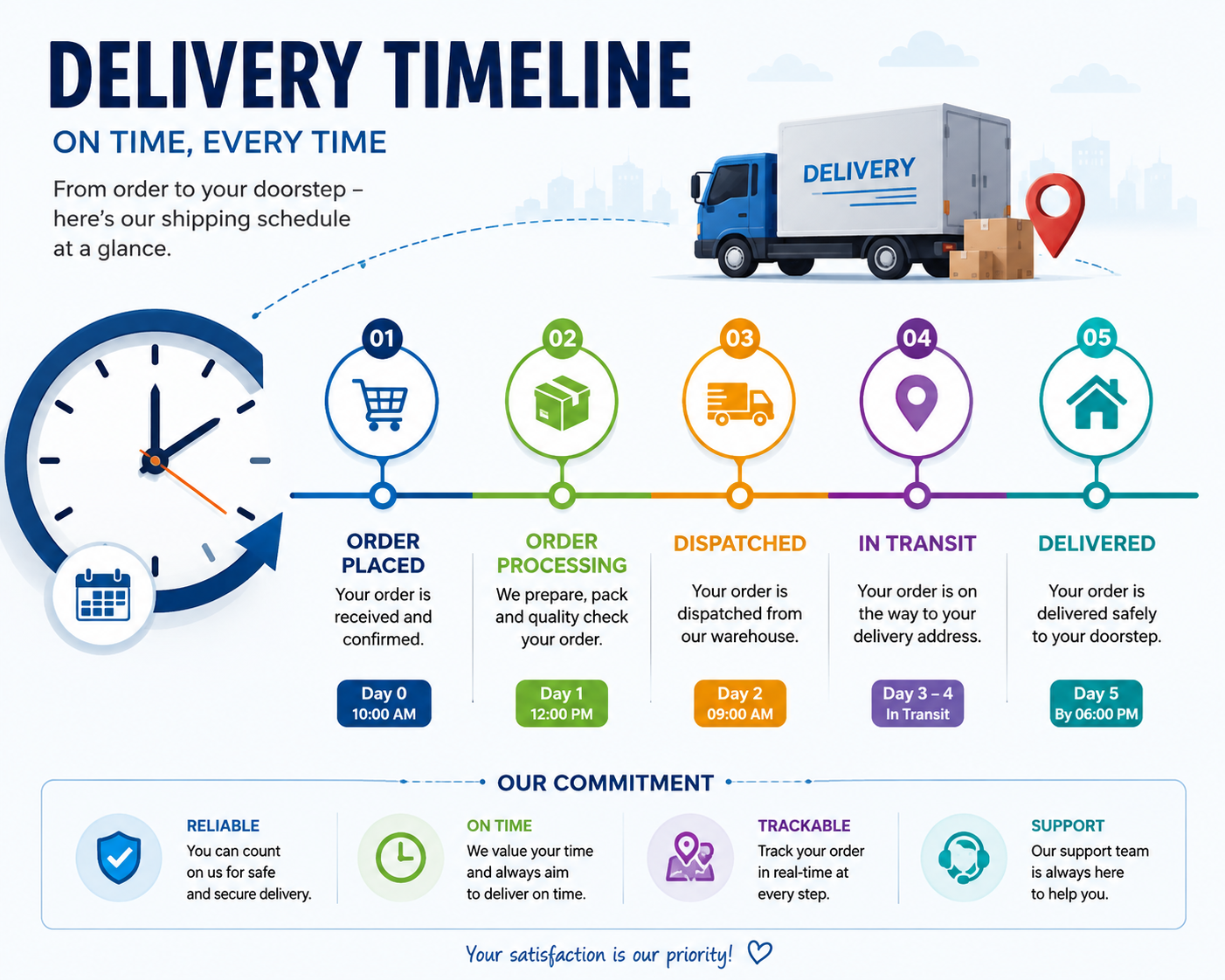
The delivery estimate on a Shopify checkout page looks like a single number, but it's actually the sum of several separate stages that each carry their own variability. Get the math wrong showing an optimistic best-case number instead of a realistic one and the result is a customer whose expectations were set up to be broken from the moment they clicked "buy."
Here's how to actually build that number out stage by stage, so what's promised at checkout matches what customers experience in reality.
📋 Table of Contents
The Four Stages Behind Every Delivery Estimate
A checkout-to-delivery timeline for China-sourced fulfillment breaks down into four distinct stages: order processing time at the warehouse (from order placement to the package leaving the facility), transit time (the shipping method's actual travel duration), customs clearance (which can add anywhere from minimal to significant time depending on documentation and shipment type), and final-mile delivery (the last leg to the customer's actual address once the package has cleared customs and entered the destination country's domestic network).
Where Delivery Estimates Commonly Go Wrong
Common ETA Mistakes
- Showing only carrier transit time, ignoring warehouse processing time
- Using best-case shipping speed instead of typical or average performance
- Not accounting for customs clearance time at all
- Failing to adjust estimates during known peak season slowdowns
What an Accurate Estimate Accounts For
- Processing time based on actual, current warehouse performance
- Realistic, typical transit time rather than the fastest possible case
- A reasonable allowance for customs clearance variability
- Seasonal adjustments during known high-volume periods
How to Calculate an Accurate ETA
Start with your fulfillment agent's actual average processing time, not their best-case number. Add the shipping method's typical transit time based on real historical performance for your specific shipping lane, not a carrier's advertised estimate. Layer in a reasonable customs clearance allowance, which varies by shipment type and destination country. Finally, add final-mile delivery time once the package has entered the destination country's domestic postal or courier network. The resulting sum, with a modest buffer added on top, is a defensible number to show at checkout.
This calculation should be built directly into your Shopify delivery date and shipping settings, ideally pulling from real fulfillment performance data rather than a static, manually-set number that goes stale over time.

Data You Need from Your Fulfillment Partner
- Actual average processing time — request real historical data, not a target or best-case figure
- Shipping method-specific transit times — get typical transit performance for each shipping option offered, not just the fastest one
- Customs clearance history — ask about typical clearance times and any recurring delay patterns for your product category
- Peak season adjustments — confirm how much processing and transit times typically extend during high-volume periods
- Regular data updates — set up a process to refresh these numbers periodically, since fulfillment performance shifts over time
Sample Timeline Breakdown by Stage
| Stage | Typical Range | Key Variable |
|---|---|---|
| Order Processing | Same-day to 2 days | Warehouse volume and staffing |
| Transit (Standard) | 10-20 days | Shipping method chosen |
| Transit (Express) | 3-7 days | Shipping method chosen |
| Customs Clearance | Minimal to several days | Documentation accuracy, shipment type |
| Final-Mile Delivery | 1-3 days | Domestic carrier network |
Adjusting Estimates for Peak Season and Edge Cases
-
Widen Estimates Ahead of Peak Season
Adjust the checkout estimate proactively before BFCM or other high-volume periods, based on historical peak season performance rather than standard-month figures.
-
Narrow Estimates Once Data Supports It
If actual performance consistently beats the current estimate over several months, tightening the number can be a legitimate competitive advantage worth reflecting.
-
Review Quarterly at Minimum
Set a recurring reminder to compare actual delivery performance against the estimate shown at checkout, adjusting whenever a meaningful gap appears in either direction.
Want Delivery Estimates You Can Actually Trust?
OneShipPros provides real performance data across processing, shipping, and customs, so Shopify sellers can set checkout estimates that hold up.
Get Started with OneShipPros →