
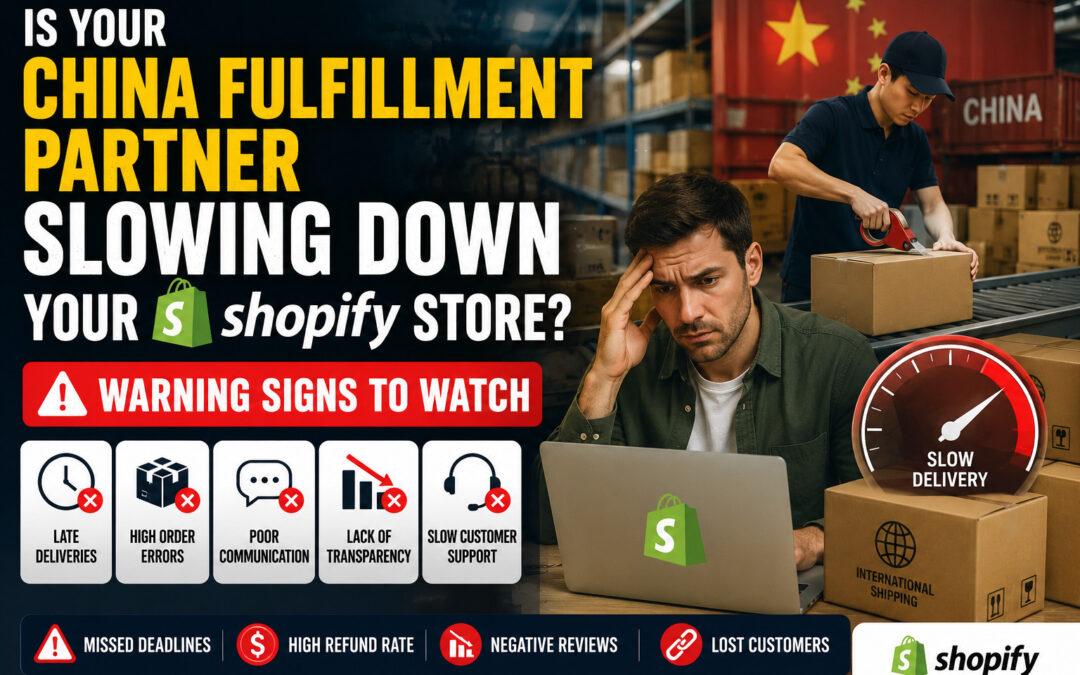
Is Your China Fulfillment Partner Slowing Down Your Shopify Store? Warning Signs to Watch
Fulfillment problems rarely announce themselves all at once. They show up as small, easy-to-dismiss issues that build quietly until customers start noticing. Here are the specific warning signs worth checking for before they turn into a real problem.
Most sellers don't wake up one day to a fulfillment disaster. It's usually gradual a processing time that creeps up a little, a support response that takes a bit longer than it used to, an inventory count that's occasionally off by a few units. Each one is easy to dismiss individually. Together, over a few months, they add up to a fulfillment partner that's quietly become a drag on the business.
The goal here isn't paranoia toward every hiccup it's knowing which signs are worth paying attention to before they compound into something bigger.
📋 Table of Contents
Why Fulfillment Decline Is Easy to Miss
Fulfillment performance rarely collapses overnight. A partner that was excellent when a store had 50 orders a month can quietly struggle to maintain the same standard at 500, without anyone officially noticing the shift. Without specific metrics being tracked, this kind of gradual decline often only becomes visible once customer complaints start piling up which is a much more expensive way to find out than checking the numbers directly.
The Core Warning Signs to Watch For
Red Flags Worth Investigating
- Order processing time creeping up over recent months
- Rising order accuracy errors (wrong item, quantity, or address)
- Increasingly frequent inventory sync discrepancies
- Slower or vaguer responses to support inquiries
- A growing number of shipping-related customer complaints or reviews
Signs Things Are Actually Fine
- Processing times remain steady even as order volume grows
- Order accuracy stays consistently high
- Inventory counts match reality with rare, quickly resolved exceptions
- Support responses remain prompt and specific
How to Confirm a Suspected Problem Is Real
Before assuming a fulfillment partner is genuinely declining, it's worth confirming the suspicion with actual data rather than a general feeling. Pull processing time and accuracy numbers from the last three to six months and look for a trend, not just a bad week. Cross-reference customer complaints against actual order dates to see if there's a real correlation with fulfillment performance, rather than coincidental timing.
Much of this data should already be visible through your Shopify order and fulfillment reporting, which is worth reviewing alongside whatever performance reports your fulfillment agent provides directly.

Questions to Ask Before Assuming the Worst
- Has order volume genuinely increased? — sometimes performance dips are tied to a temporary surge rather than a systemic decline
- Is the issue isolated to specific SKUs or order types? — a problem limited to one product line points to something more specific than an overall partner decline
- Has anything changed on the fulfillment agent's side? — staffing changes, new systems, or a facility move can cause temporary dips that resolve on their own
- Is there a documented SLA being missed? — if specific commitments exist, check whether they're actually being violated, not just informally underperforming
- Have you raised the issue directly yet? — sometimes what looks like decline is a fixable miscommunication once flagged
Isolated Issue vs Genuine Pattern: How to Tell the Difference
| Signal | Isolated Issue | Genuine Pattern |
|---|---|---|
| Duration | A single week or short period | Consistent over several weeks or months |
| Scope | Limited to one SKU or order type | Spread across multiple SKUs or all orders |
| Trend Direction | Returns to normal on its own | Continues worsening over time |
| Explanation Available | Tied to a known, temporary cause | No clear cause, unexplained decline |
What to Do Once a Pattern Is Confirmed
-
Bring Data, Not Just Frustration
Present specific numbers and examples when raising the issue this makes the conversation productive rather than vague, and gives the partner something concrete to respond to.
-
Set a Clear Improvement Timeline
Agree on specific, measurable improvement targets and a timeframe to reassess, rather than an open-ended "we'll do better" commitment.
-
Reassess and Decide
If performance genuinely improves within the agreed timeframe, continue the relationship; if the pattern persists despite the conversation, it may be time to evaluate other options.
Concerned About Your Current Fulfillment Performance?
OneShipPros provides transparent performance reporting, so Shopify sellers always know exactly how their fulfillment is actually performing.
Get Started with OneShipPros →