
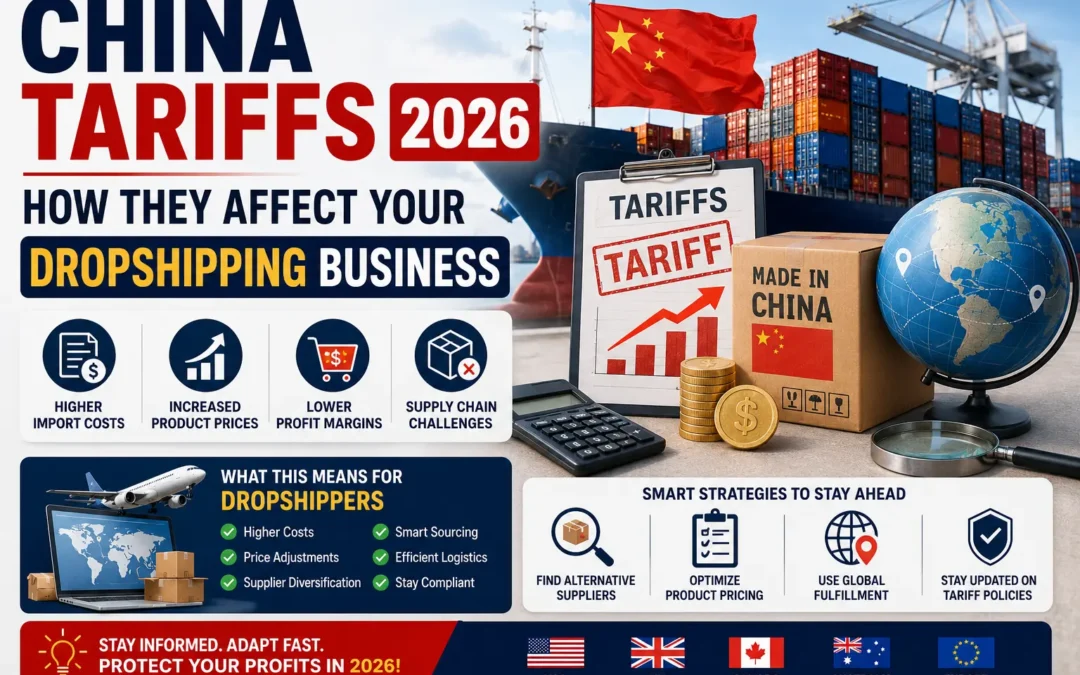
China Tariffs 2026 — How They Affect Your Dropshipping Business
US tariffs on Chinese imports hit historic highs in 2026 — but the picture for dropshippers is more nuanced than the headlines suggest. Here is what actually affects your store, your margins, and your sourcing decisions.
In 2026, US tariffs on Chinese imports have reached historic levels — with some product categories facing duties above 100%. Headlines declaring "the end of China dropshipping" are everywhere. They are wrong — but they are not entirely without cause. The tariff situation does require dropshippers to understand the rules and adapt.
The good news: most individual dropshipping orders are still protected by the de minimis exemption, and sellers using a China Fulfillment Agent for factory-direct pricing have a 30–50% cost buffer that absorbs tariff pressure far more easily than sellers still sourcing from AliExpress retail.
📋 Table of Contents
Current China Tariff Rates by Product Category (2026)
US tariffs on Chinese goods have been applied in layers across multiple trade actions. The rate your product faces depends on its Harmonized System (HS) classification.
| Product Category | Tariff Rate 2026 | Risk for Dropshippers |
|---|---|---|
| Consumer Electronics | 25% – 145% | Very High — avoid bulk import |
| Solar / Clean Energy | 50% – 100%+ | Very High — category to avoid |
| Steel & Aluminum Products | 25%+ | High — avoid heavy metal items |
| Kitchen & Household | 7.5% – 25% | Medium — check HS code first |
| Home Decor & Gifts | 7.5% – 15% | Medium — manageable margins |
| Fashion Accessories | 7.5% – 12% | Low — great niche for 2026 |
| Beauty & Skincare | 5% – 7.5% | Low — strong dropshipping category |
| Pet Products | 7.5% | Low — safe and growing market |
| Toys & Novelty | 7.5% | Low — broad category |
The De Minimis Exemption — What Every Dropshipper Must Know
The single most important piece of tariff knowledge for China dropshippers in 2026 is the de minimis exemption. Under US customs law, shipments valued at $800 or less per person per day are exempt from formal customs entry and import duties — regardless of where they originate.
$800 Threshold
Shipments under $800 enter the US duty-free. Most individual dropshipping orders qualify easily.
Per Shipment Rule
Each order shipped from China to one customer is assessed individually — not in aggregate.
Monitor Policy
The de minimis threshold has faced Congressional review. Check CBP updates throughout 2026.
Bulk Risk
Importing bulk inventory to a US warehouse is fully subject to tariffs — de minimis does not apply.
Real Impact on Your Dropshipping Margins
| Cost Factor | AliExpress Seller | Fulfillment Agent Seller |
|---|---|---|
| Product cost (example) | $8.00 (retail) | $4.50 (factory-direct) |
| Tariff (7.5% bulk scenario) | +$0.60 | +$0.34 |
| Shipping to USA | $5.00 | $4.00 |
| Total landed cost | $13.60 | $8.84 |
| Sell price | $24.99 | $24.99 |
| Gross margin | 45.6% | 64.6% |
High-Risk vs Safe Product Categories in 2026
Avoid — High Tariff Exposure
Electronics with chips, solar products, steel goods, EV components, industrial machinery.
Tariff: 25–145% — High risk categoryMonitor — Medium Exposure
Kitchen appliances, household goods, general sporting goods, some tools.
Tariff: 7.5–25% — Check HS codeSafe — Low Tariff Rates
Fashion accessories, beauty, skincare, pet supplies, toys, novelty gifts, home decor.
Tariff: 5–7.5% — Strong 2026 nichesDe Minimis Protected
Any product under $800 per direct-to-consumer shipment from China.
Duty: $0 — Monitor policy changes5 Strategies to Protect Your Dropshipping Margins from Tariffs
Switch to Factory-Direct Sourcing Immediately
The single highest-impact move. OneShipPros sources directly from the same factories that supply AliExpress sellers — at 30–50% lower cost. This margin buffer alone handles most tariff rate scenarios without touching your retail price.
Audit Your Product's HS Code
Every product has a Harmonized System tariff code determining its exact duty rate. Look up your product on the USITC Tariff Database (usitc.gov). Your fulfillment agent can help identify the correct HS classification. This simple step tells you your exact real tariff exposure.
Adjust Retail Pricing by 5–10% Where Needed
If your category has real tariff exposure, a modest 5–10% retail price increase covers most impact without hurting conversion. At a $30 sell price, a $1.50–$3.00 adjustment is typically invisible to customers when your product solves a real problem well.
Pivot Toward Low-Tariff Niches
If your current niche faces high tariff rates, 2026 is a good time to evaluate adjacent categories. Fashion accessories, beauty, home decor, pet products, and novelty gifts face 5–7.5% duties — significantly lower than electronics. Read our guide on best dropshipping niches from China in 2026.
Monitor CBP Policy Weekly
The de minimis exemption is the most critical protection for direct-to-consumer dropshipping from China. Subscribe to US Customs and Border Protection trade alerts and follow US trade policy news. If the threshold changes, you need to know within days to adjust pricing and margins.
Why a China Fulfillment Agent Is Your Best Tariff Defence
Tariffs are a cost pressure — and cost pressures are beaten by lowering other costs. The most powerful lever available to you is product cost, and a China Fulfillment Agent gives you factory-direct pricing that no AliExpress seller can match.
- Factory-direct pricing — 30–50% lower product costs create a natural buffer against any tariff rate increases
- Accurate HS classification — experienced agents know which codes apply and ensure accurate customs declarations
- Direct-to-consumer shipping — every order ships individually, each qualifying for the de minimis exemption
- No bulk inventory exposure — no warehouse, no bulk import, no tariff burden on stock you hold
- Rapid niche pivoting — if a category faces new tariff exposure, your agent sources alternatives in days
Tariff-Proof Your Dropshipping Business
OneShipPros gives you factory-direct pricing — your most powerful defence against any tariff environment. No monthly fees. No contracts. Just better margins from day one.
See Our Fulfillment Services →