
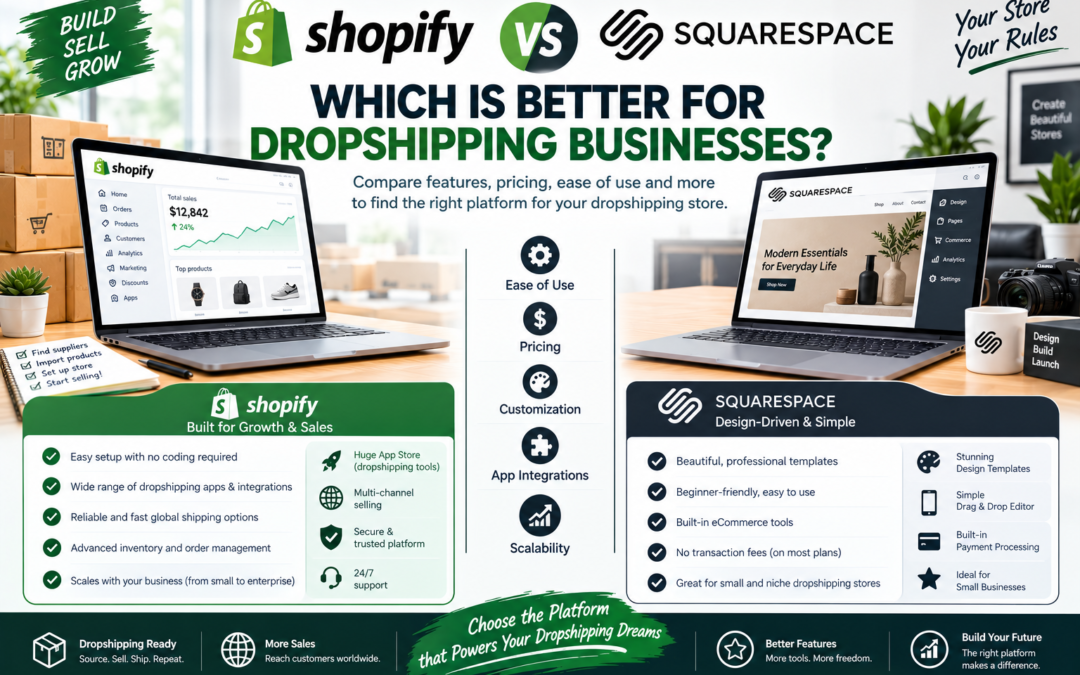
Shopify vs Squarespace: Which Is Better for Dropshipping Businesses?
Squarespace has a well-earned reputation for beautiful, design-forward templates. That reputation doesn't automatically translate into strong dropshipping support, though, since Shopify was purpose-built for exactly this kind of ecommerce model. Here's how the two actually compare for a dropshipping business specifically.

Squarespace built its reputation on visually striking, design-forward websites, portfolios, blogs, and increasingly, online stores. Shopify's reputation was built specifically around ecommerce, and dropshipping in particular has a deep, mature app ecosystem on the platform. For a dropshipping business, that difference in origin and focus tends to matter more than it might for a simpler online store.
Here's how Shopify and Squarespace actually compare for someone running, or planning to run, a dropshipping business.
📋 Table of Contents
Dropshipping App Support
This is where the gap between the two platforms is most pronounced. Shopify's app store includes a large, mature set of dropshipping-specific tools, supplier integrations, automated order routing, inventory syncing, built and refined specifically for this business model over many years. Squarespace's integration options for dropshipping are comparatively limited, reflecting the platform's broader design-first focus rather than deep ecommerce specialization.
Shopify for Dropshipping
- Large, mature dropshipping app ecosystem
- Automated supplier and order integrations
- Well-tested inventory syncing tools
- Strong track record supporting dropshipping specifically
Squarespace for Dropshipping
- Fewer dropshipping-specific integrations available
- Less mature ecommerce automation tooling
- Design-first focus, ecommerce is a secondary strength
- Smaller developer community for ecommerce apps
Design and Visual Presentation
Squarespace's templates are consistently praised for looking polished and professional with minimal customization effort, a genuine advantage for a brand where visual presentation is a major differentiator. Shopify's themes are solid and can look equally professional, but generally require a bit more customization work to achieve the same immediately striking visual impact that a good Squarespace template offers out of the box.

Scalability for a Growing Dropshipping Business
- Shopify's ecommerce infrastructure — built specifically to handle growing order volume, larger catalogs, and complex fulfillment needs at scale
- Squarespace's ecommerce ceiling — functional for smaller operations, but less proven at higher volumes or with complex dropshipping workflows
- App availability as you grow — Shopify's larger ecosystem means more options exist as a dropshipping business's needs become more sophisticated
- Consider your growth trajectory honestly — a small, design-focused dropshipping store might never hit the ceiling where this difference matters
Learning Curve and Setup
Both platforms are designed to be approachable for non-technical users, though they're optimized differently. Squarespace leans toward visual, design-first setup, while Shopify's setup process is more structured around ecommerce-specific configuration, products, variants, shipping rules, payment gateways. For dropshipping specifically, Shopify's guided setup tends to map more directly onto the actual workflow a dropshipping business needs to configure.
Shopify vs Squarespace at a Glance
| Factor | Shopify | Squarespace |
|---|---|---|
| Dropshipping App Support | Strong, mature ecosystem | Limited |
| Visual Design Out of the Box | Requires more customization | Polished with less effort |
| Scalability | Stronger for growth | Better suited to smaller scale |
| Ecommerce-Specific Setup | Deep, structured tooling | Lighter ecommerce focus |
Which Platform Fits Your Dropshipping Business
-
Prioritize Dropshipping App Needs
If your business relies on supplier integrations, automated order routing, or inventory syncing, Shopify's ecosystem is likely to serve those needs more reliably.
-
Weigh Design Against Functionality Honestly
If exceptional out-of-the-box visual design genuinely matters more to your brand than deep ecommerce automation, Squarespace remains a reasonable option.
-
Think About Where the Business Is Headed
Consider not just current needs but where the dropshipping business is likely to be in a year or two, and choose the platform that scales with that trajectory.
Running a Dropshipping Business on Shopify?
OneShipPros helps Shopify dropshipping sellers source and fulfill orders reliably from China.
Get Started with OneShipPros →