
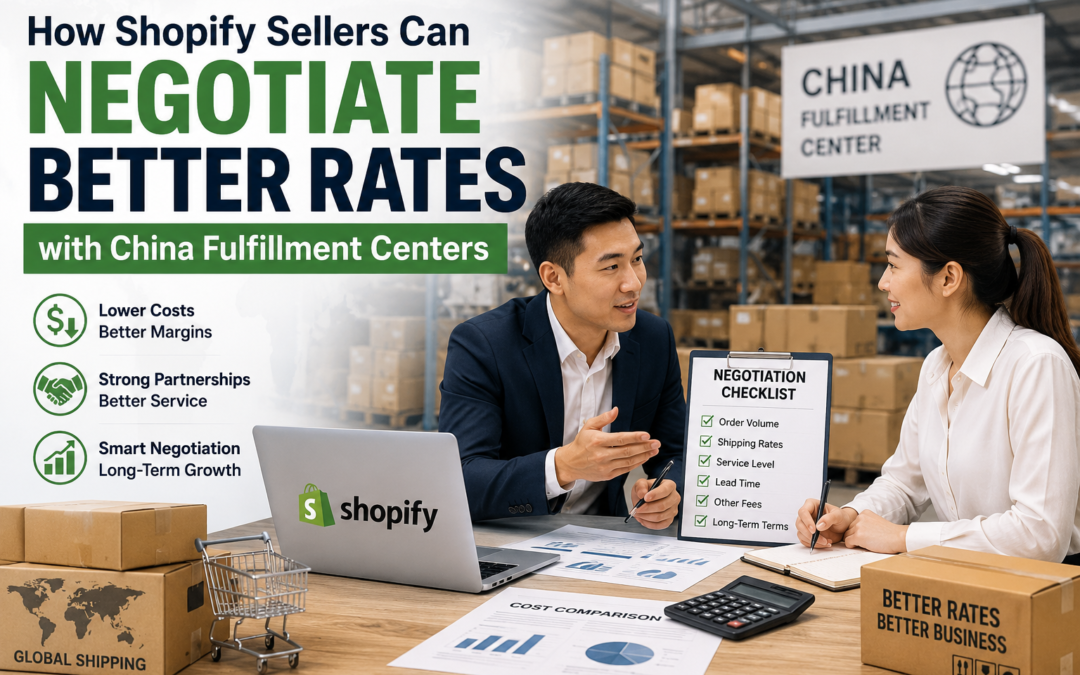
How Shopify Sellers Can Negotiate Better Rates with China Fulfillment Centers
Most published fulfillment rate cards aren't the final word, they're a starting point. Sellers who never ask rarely get a better deal, and sellers who ask without the right leverage rarely get much either. Here's how to approach negotiating rates with a China fulfillment center in a way that actually works.

Published fulfillment pricing is often a starting point rather than a fixed number, especially for storage fees, per-order handling, and bulk shipping rates. Whether a seller actually gets a better rate usually comes down to timing, leverage, and how the conversation is approached, not just asking nicely. Sellers with a track record of consistent volume have real room to negotiate; brand-new accounts have less, but not none.
Here's a practical look at how Shopify sellers can approach negotiating rates with a China fulfillment center, and what actually moves the needle.
📋 Table of Contents
What's Actually Negotiable
Per-order fulfillment fees, storage rates, and shipping rates are the most commonly negotiable line items, particularly for sellers committing to consistent volume. Deposit requirements and billing terms can sometimes flex as well. What's less likely to move is anything tied to genuine third-party costs, like actual carrier shipping rates the warehouse itself doesn't fully control, though even markup on those can occasionally be discussed.
What Happens Without Negotiating
Cost of Not Negotiating
- Paying full published rates even at meaningful volume
- Missing out on savings a warehouse would have offered if asked
- No competitive pressure encouraging better service over time
- Margins eroded unnecessarily as volume scales
What Negotiating Provides
- Potentially meaningful savings on recurring fulfillment costs
- A relationship where terms improve alongside growth
- Clarity on what a warehouse actually values in a seller relationship
- Better margins that compound as volume increases
Building Real Negotiating Leverage
The strongest negotiating position comes from demonstrated, consistent order volume, a warehouse has clear financial incentive to retain a seller generating predictable, valuable business. A genuine competing quote from another fulfillment provider is also strong leverage, though it's worth using honestly rather than as a bluff, warehouses often have a good sense of realistic market rates. Even without high volume yet, being upfront about growth plans and a realistic timeline can open a conversation, even if it doesn't move pricing immediately.

Timing the Conversation Right
- Contract renewal points — this is a natural, low-pressure moment to raise rate discussions, since the relationship is already up for review
- After a track record is established — waiting until several months of consistent volume exist gives real data to point to, rather than projections
- Before a significant volume increase — flagging an upcoming growth spike gives a warehouse advance notice and a reason to lock in favorable terms early
- Not during an active service issue — negotiating rates while resolving an unrelated service problem tends to muddy both conversations
New Account vs Established Account Leverage
| Factor | New Account | Established Account |
|---|---|---|
| Negotiating Leverage | Limited | Stronger |
| Data Available | Projections only | Actual volume history |
| Realistic Ask | Modest concessions, flexibility | More substantial rate improvements |
| Best Approach | Be upfront about growth plans | Point to consistent track record |
How to Approach the Conversation
-
Gather Your Actual Volume Data
Pull together concrete numbers on order volume, storage usage, and growth trend before starting the conversation, specifics carry more weight than general claims.
-
Ask Directly and Specifically
Name the specific fee or rate you're asking about, rather than a general request for a better deal, this is easier for the warehouse to actually respond to.
-
Be Prepared to Discuss Trade-Offs
A warehouse may offer better rates in exchange for a longer contract term or higher committed volume, be ready to evaluate whether that trade makes sense for your business.
Looking to Optimize Your Fulfillment Costs?
OneShipPros offers transparent, scalable pricing that grows with your Shopify store.
Get Started with OneShipPros →